

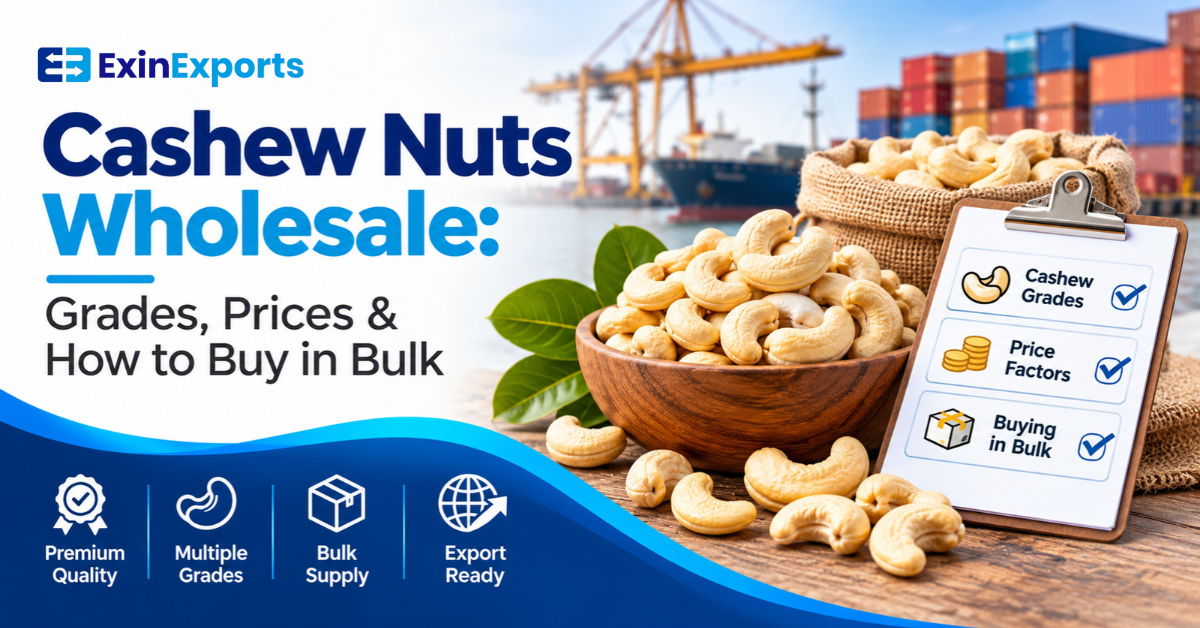
If you run a sweet shop, bakery, dry fruit store or catering business, you already know cashews aren’t cheap. Picking up 1 kg packets from a retail counter every week eats into your margin fast. That’s why most food businesses switch to cashew nuts wholesale once their monthly use crosses 20 to 25 kg.
But bulk buying has its own traps. Grades get mixed, moisture creeps in, and the rate you’re quoted on the phone isn’t always the rate that reaches your door. This guide covers grades, current price ranges and a simple buying process. If you also stock spices, grains or other dry fruits, take a look at our agro products range for bulk options.
What W180, W240 and W320 Actually Mean
Cashew grades look confusing at first. They’re simple once you know the rule.
The “W” stands for White Wholes. The number tells you how many kernels make up one pound (about 454 g). So W180 means roughly 170 to 180 nuts per pound. A lower number means a bigger nut and a higher price.
Whole Cashew Grades
- W (White Wholes): Full, unbroken kernels with an even ivory colour. Used for gifting and retail packs.
- SW (Scorched Wholes): Whole kernels with a light brown tint from longer roasting. They taste the same and cost less.
Splits and Pieces
- S / JH (Splits): Kernels split naturally into two halves.
- LWP (Large White Pieces): Big broken pieces, popular with sweet makers.
- SWP and BB (Small Pieces and Baby Bits): Small fragments used in bakery, ice cream and namkeen.
One practical tip: if you make kaju katli, you’re grinding the cashews anyway. Paying for W240 makes no sense. LWP or splits will give you the same taste at a much lower cost.
How Cashew Nuts Are Made: From Farm to Packet
Most buyers never ask how cashew nuts are made. It’s worth knowing, though, because the process explains most of the price gap between grades.
The raw cashew nut grows at the bottom of the cashew apple, inside a hard shell. That shell holds a caustic oil, so the nut can’t simply be cracked open by hand.
The Processing Steps
Processing units in Kollam, Panruti, Palasa and Mangaluru follow roughly this sequence:
- Raw nuts are sun-dried to bring down moisture.
- They’re steamed or roasted so the shell softens.
- The shell is cut open, mostly by machine now, with some manual work still done.
- Kernels are dried again so the thin brown skin (testa) loosens.
- The skin is peeled off and kernels are graded by size and colour.
- Graded cashews are packed in vacuum tins or gas-flushed pouches.
Why Whole Grades Cost More
Every crack during shelling turns a potential whole into a split. Once you know how cashew nuts are made, it’s easy to see why whole grades cost more. The factory simply gets fewer of them from each batch.
Cashew Nuts Wholesale Price in India (Grade-Wise)
The cashew nuts wholesale price shifts with the crop season, the cost of raw nuts imported from Africa, and festive demand. Rates almost always firm up between August and October, ahead of Diwali gifting.
Grade-Wise Price Table
Here’s a reference based on recent B2B listings:
| Grade | Kernels per lb | Best For | Indicative Price (₹/kg) |
| W180 | 170–180 | Premium gift boxes | 1,050 – 1,350 |
| W210 | 200–210 | Premium dry fruit packs | 900 – 1,050 |
| W240 | 220–240 | Retail packs, hotels | 780 – 900 |
| W320 | 300–320 | Sweets, snacks, daily use | 700 – 850 |
| W450 | 400–450 | Budget snacks, namkeen | 650 – 750 |
| Splits / LWP | — | Kaju katli, gravies, bakery | 450 – 650 |
Check the Final Landed Cost
Treat these as a starting point, not a final quote. Before you compare any cashew nuts wholesale price, check whether it includes GST, packing and freight. A rate that looks ₹40 cheaper per kg can end up costlier once transport gets added.
Buying in container loads or for overseas markets? Pricing and packing work a little differently at that scale. Our page on Cashew Nuts Export from India explains what to expect.
Cashew Nuts Wholesale Dealers vs Direct Processors
You have two main routes for buying, and each one suits a different kind of buyer.
When a Local Dealer Makes Sense
Local cashew nuts wholesale dealers in dry fruit markets are quick and flexible. You can pick up 10 kg today and another 10 kg next week. The trade-off is a slightly higher rate, since the dealer adds his margin.
Take a sweet shop in Ahmedabad that uses about 40 kg a month. Buying cashew nuts wholesale through a local dealer makes more sense for them than locking cash into 200 kg from a processor.
Good cashew nuts wholesale dealers will happily send a sample before you commit. If someone refuses, treat that as a warning sign.
When to Buy Direct from Processors
Processors and direct sourcing companies work out cheaper per kilo, but they usually ask for a larger minimum order, often 100 kg or more. A dry fruit retailer moving 500 kg before Diwali is better off going direct.
Combine Orders to Save on Freight
Here’s a tip many retailers miss: if you also stock almonds, raisins or pistachios, buy them from the same source as your cashews. One combined shipment cuts your freight cost per kilo. See our range of Dried Fruits and Nuts Export from India if you’re planning a mixed order.
How to Choose the Right Cashew Supplier
A good cashew supplier isn’t necessarily the cheapest one. Consistency matters more. You want the 20th order to match the first.
Quality Checklist Before You Order
- Ask for their FSSAI licence number and check that it’s valid.
- Request a 250 g sample from the exact lot you’ll be buying.
- Weigh out 454 g and count the kernels yourself to confirm the grade.
- Check for broken pieces in whole grades (anything above 5% is too much).
- Smell the sample. Rancid or musty notes mean old stock or poor storage.
- Confirm packing type: vacuum tins or nitrogen-flushed pouches last longer.
- Get GST, delivery charges and payment terms in writing.
Also, only move to a new cashew supplier after two or three small trial orders. One good sample doesn’t prove much.
Simple Tips for Buying Cashews in Bulk
Plan by Usage and Season
Start by working out your monthly usage per grade. Most businesses need two grades, not five.
Timing helps a lot. India’s harvest runs roughly from February to May, so fresh stock arrives in early summer, when rates tend to be softer. Buying part of your festive stock in June or July can save you a decent amount compared with a last-minute September purchase.
Store Cashews the Right Way
Keep unopened tins in a cool, dry place. Once opened, move the cashews into airtight containers and use them within a month or two. Cold storage extends that comfortably.
Know Where Your Cashews Come From
Much of India’s crop comes from small farms in Kerala, Goa and Odisha, and the quality you get depends on how well those growers connect with processors and buyers. This piece on Indian Farm Suppliers shows how that sourcing chain works.
Final Thoughts
Buying cashew nuts wholesale gets much easier once you know your grade, understand price movements and have a reliable source. Start small, test samples, and scale up once quality stays steady.
If you’re ready to stock up, send us your grade and quantity and we’ll share a clear, honest quote.
FAQs
1. Which cashew grade is best for making sweets?
W320 works well for sweets that show the whole nut. For kaju katli or anything ground, splits or LWP give the same taste at a lower cost.
2. What is the minimum order when buying cashews in bulk?
Local dealers usually sell from 5 to 10 kg. Processors and direct sourcing companies often start at 100 kg, typically packed in 10 kg tins.
3. How long do bulk cashews stay fresh?
Vacuum-packed tins keep for 6 to 12 months in cool, dry storage. After opening, use them within 1 to 2 months, or refrigerate them for longer life.
4. Why are W180 cashews so expensive?
Very few kernels in any batch are large enough to qualify as W180. Low supply and strong gifting demand keep the price high.
5. How can I check cashew quality before placing a big order?
Ask for a sample, count the kernels per pound, check the colour and smell, and look at the broken percentage. Then place a small trial order before committing to a large one.