

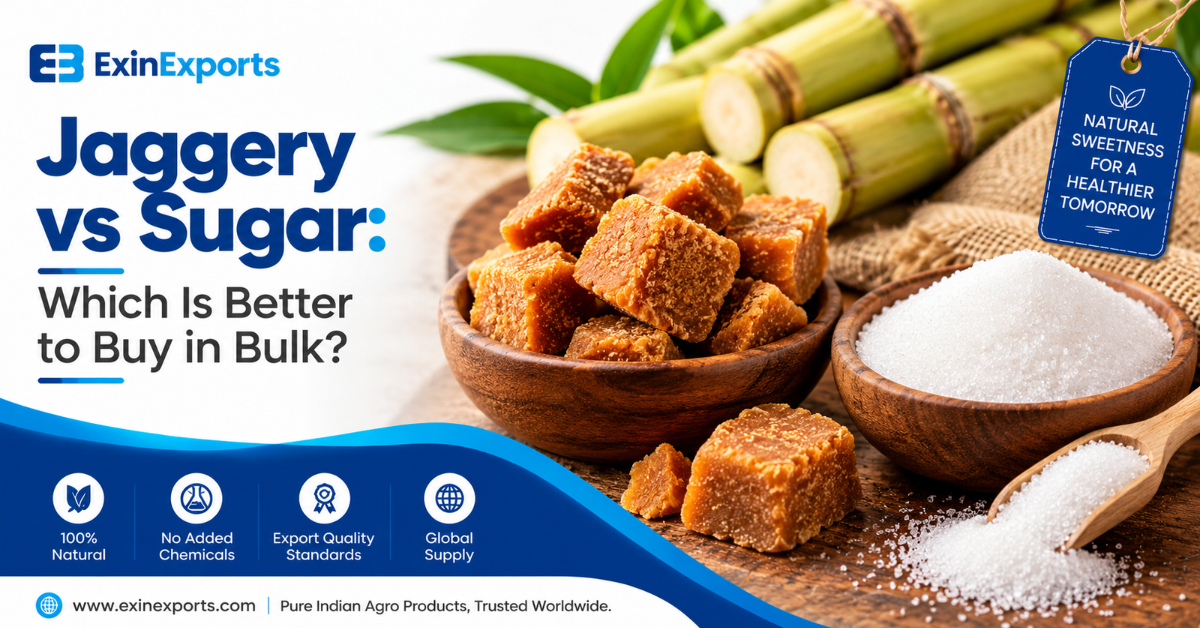
Walk into any kirana store in India and you’ll find both on the same shelf. Sugar sells faster. Jaggery sells to people who ask for it by name. If you run a food business, the jaggery vs sugar question isn’t only about taste. It decides your cost per kilo, your shelf life and what you can print on the pack.
We talk to bulk buyers every week, and the honest answer depends on what you’re making. A chikki brand in Pune and a tea stall chain in Ahmedabad need very different things. If you’re already leaning toward natural sweeteners, our organic jaggery export page lists the grades and packing options we supply.
The Short Answer
Buy sugar if you need the lowest cost, a long shelf life and a neutral taste. Buy jaggery if your product sells on words like “natural” or “unrefined,” or if the recipe needs that deep caramel flavour. Most food brands end up stocking both: sugar for volume, jaggery for premium lines.
What Is Better Sugar or Jaggery?
Ask ten people what is better sugar or jaggery and nine will say jaggery. They’re mostly right on nutrition. But the gap is smaller than most people think.
Both come from sugarcane. Jaggery is made by boiling cane juice in open pans until it thickens and sets into blocks. Nothing is spun out. Refined sugar goes through clarification, crystallisation and centrifuging until it’s about 99.8% pure sucrose, with almost everything else removed.
So when a buyer asks me what is better sugar or jaggery, I ask a question back. Better for what? Health claims on the label? Lower cost per kilo? A product that sits in a warehouse for two years? Each answer points somewhere different.
Jaggery vs Sugar: Side-by-Side Comparison
| Factor | Jaggery | Refined Sugar |
| Processing | Boiled cane juice, unrefined | Fully refined and crystallised |
| Sucrose content | Around 65–85% | Around 99.8% |
| Calories (per 100 g) | Approx. 383 kcal | Approx. 387 kcal |
| Minerals | Small amounts of iron, potassium, magnesium | Practically none |
| Taste | Earthy, caramel-like | Clean, neutral sweetness |
| Shelf life | 6–12 months if kept dry | 2 years or more |
| Moisture risk | High, turns sticky in humidity | Low |
| Cost per kg | Higher | Lower |
| Best for | Chikki, laddoos, health snacks, premium tea | Beverages, biscuits, daily sweets |
Jaggery vs Sugar Benefits
Let’s be fair about the jaggery vs sugar benefits debate. Jaggery isn’t a superfood. The calories are almost the same, and your blood sugar still goes up after eating it.
Where jaggery wins is in what it keeps. Because the molasses stays in, you get small amounts of iron, potassium and magnesium. Many Indian families eat a small piece after lunch for digestion. That habit is old and common, though the science behind it is still thin.
Sugar’s advantage is boring but real. It’s consistent. Every batch dissolves the same way and tastes the same, and for a mithai shop making 500 kg of barfi a day, that predictability is worth a lot of money.
For a business, the jaggery vs sugar benefits mostly show up on the label. “Sweetened with jaggery” lets a product sell at a higher price. “Contains sugar” doesn’t.
Jaggery vs Brown Sugar: What’s the Difference?
This one confuses a lot of buyers. Brown sugar looks rustic, so people assume it’s close to jaggery. It isn’t.
Most commercial brown sugar is refined white sugar with a little molasses sprayed back on, usually between 3% and 7%. Jaggery never loses its molasses in the first place. In a straight jaggery vs brown sugar comparison, jaggery has more minerals and a richer flavour, while brown sugar is cheaper and easier to measure in recipes.
Bakers abroad often pick brown sugar simply because every supermarket stocks it. For an Indian brand, the jaggery vs brown sugar choice usually tips toward jaggery. It’s local, easy to source in bulk and customers already trust it.
Is Jaggery Better Than Sugar for Health?
Slightly, yes. But is jaggery better than sugar enough that you can eat it freely? No.
Jaggery has a high glycemic index, roughly in the same range as sugar. Anyone with diabetes should treat both the same way and follow their doctor’s advice. The minerals help a little, but you’d need to eat a lot of jaggery to get meaningful iron, and that defeats the purpose.
Where the question of whether is jaggery better than sugar really matters is quality. Some low-cost jaggery is cleaned with chemicals like sodium hydrosulphite to make it look bright and golden. Darker, chemical-free jaggery is usually the safer pick. For more on uses and storage, read our guide on organic jaggery powder.
Sugar or Jaggery Which Is Better for Bulk Buyers?
Here’s how I’d work out sugar or jaggery which is better for your business. Start with your product, not the trend.
When Sugar Makes More Sense
High-volume, low-margin products: soft drinks, biscuits, everyday sweets and tea stalls. Sugar costs less per kg, stores for years in a dry godown and won’t clump during the monsoon.
When Jaggery Is the Better Buy
Premium and health-focused products: chikki, laddoos, energy bars, organic tea blends and Indian foods meant for export. A Pune chikki brand can’t swap in sugar and still call its product traditional. Customers notice.
So, sugar or jaggery which is better? For cost, sugar. For brand value, jaggery. Plenty of buyers order both and use each where it fits.
Practical Tips Before You Order Jaggery in Bulk
Jaggery is less forgiving than sugar, so check these before you confirm an order:
- Ask for the source region. Kolhapur jaggery (GI-tagged) is lighter and milder, while jaggery from Muzaffarnagar is often darker with a stronger taste.
- Check the moisture report. Wetter jaggery turns sticky within weeks, especially in coastal cities.
- Pick the right form. Powder works best for bakeries and beverages, blocks for sweets and cubes for retail packs.
- Avoid very bright yellow jaggery. That colour often comes from chemical bleaching, not quality.
- Check the packing. Food-grade liners and moisture-proof bags matter far more for jaggery than for sugar.
- Test a sample first. Take it from the exact lot you’ll receive and try it in your own recipe.
Jaggery is just one part of what Indian farms supply to food brands around the world. To see the wider range, from spices to grains, read our post on Indian Farm Produce.
Final Thoughts
The jaggery vs sugar choice comes down to your product, not a health trend. Sugar keeps costs low and runs smoothly through big production lines. Jaggery earns more per pack when your customer cares about what’s inside.
If you’re testing jaggery for a new product line, start with a small sample order. See how it behaves in your recipe, then scale up once the numbers make sense.
FAQs
1. Can jaggery replace sugar in every recipe?
Mostly, yes. It adds colour and a caramel taste, so light cakes and clear drinks still work better with sugar.
2. Does jaggery have fewer calories than sugar?
No. Both have about 380–390 kcal per 100 g. The difference is in minerals, not calories.
3. How long does bulk jaggery last?
About 6–12 months in a cool, dry place with moisture-proof packing. Humidity is its biggest enemy.
4. Is jaggery safe for people with diabetes?
It raises blood sugar much like sugar does. Diabetics should limit both and follow their doctor’s advice.
5. Which form of jaggery suits food businesses best?
Powder for bakeries and beverages since it dissolves fast. Blocks work better for sweets and traditional recipes.